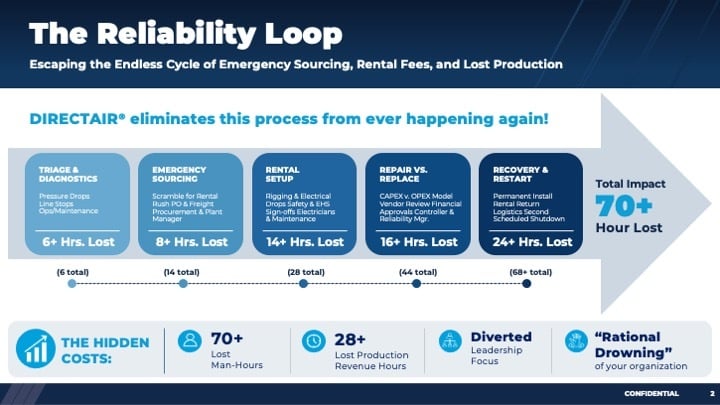
Compressed air cost in industrial facilities is driven primarily by electricity consumption, compressor efficiency, operating hours, and system design. Using the U.S. Department of Energy's formula, a single 100 horsepower (hp) compressor running 6,000 hours per year at $0.10/kWh can cost over $40,000 annually – and this is before factoring in maintenance, downtime, or system inefficiencies. When equipment fails, the true cost extends well beyond the repair itself. The Reliability Loop, the cycle of triage, sourcing rental equipment, completing repairs, and restarting operations, can add significant unplanned downtime and expense, compounding the already substantial cost of compressed air.
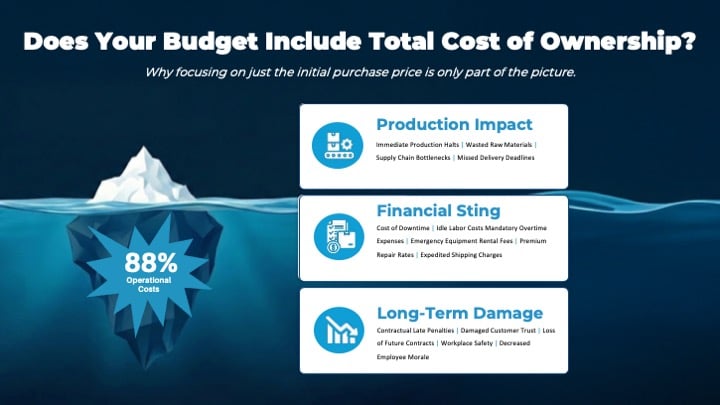
Compressed air is a manufacturer’s FOURTH UTILITYSM, right alongside electricity, water, and gas. Yet unlike those utilities, its true cost is rarely measured, optimized, and fully understood. Air compressor energy consumption accounts for the majority of compressed air cost, but the full picture includes equipment maintenance, system inefficiencies, and the often-overlooked price of unplanned downtime. This is where Total Cost of Ownership (TCO) becomes essential: when equipment fails, the financial impact extends far beyond the repair itself, encompassing lost production time, emergency rental equipment fees, overtime labor, missed delivery deadlines, contractual penalties, and long-term damage to customer trust. Understanding how these compressed air costs accumulate and where they can be reduced is the first step toward a more efficient, reliable operation.
Breaking Down Compressed Air Operating Costs
Compressed air cost is not a single line item. It's a combination of interconnected expenses that add up over time.
The largest contributor is electricity. Compressors consume significant power, and that cost scales directly with operating hours, load profile, and system efficiency. Older, poorly maintained equipment consumes more energy to produce the same output as a modern, well-optimized system.
The U.S. Department of Energy provides a standard formula for calculating compressed air energy cost:
Cost ($) = (bhp) × (0.746) × (operating hours) × ($/kWh) × (% time) × (% full-load bhp) ÷ (motor efficiency)
-
bhp = Motor full-load horsepower (often higher than the nameplate rating, check equipment specs)
-
0.746 = Conversion factor from horsepower to kilowatts
-
% time = Percentage of time running at a given operating level
-
% full-load bhp = bhp as a percentage of full-load bhp at that level
-
Motor efficiency = Motor efficiency at that operating level
Beyond energy, the full cost picture includes:
-
Air treatment equipment — Dryers, filters, and oil-free systems add capital and operating costs
-
Preventive and corrective maintenance — Routine upkeep plus unplanned repairs
-
Production interruptions — The cost of a compressor failure extends far beyond the repair bill
That last point is where the Reliability Loop becomes critical. When a compressed air system fails, the downtime doesn't stop at the repair itself. Facilities face mounting costs: diagnosing the problem, sourcing and setting up rental equipment, completing repairs, and restarting production. This process can exceed 70+ hours of lost output.
Where Industrial Compressed Air Systems Lose Efficiency
A significant portion of electricity consumed by a compressor never becomes usable compressed air. That's not a flaw in any one system, it's an inherent challenge of compressed air generation. Understanding air compressor energy consumption and where energy is lost helps identify where cost reductions are possible.
Key efficiency losses include:
-
Heat generation — Compression produces heat; without heat recovery systems, that energy is wasted
-
Idle running — Compressors that continue running during low-demand periods consume energy without producing value
-
Pressure drops — As compressed air travels through piping and fittings, pressure loss occurs, requiring the system to work harder to maintain adequate supply pressure
These losses mean that the input energy cost is always higher than the cost of the compressed air actually reaching the production floor.
Common System Design Issues That Increase Compressed Air Cost
Inefficient systems are often the result of design decisions made years ago or no deliberate design at all. Several structural issues consistently drive up air compressor energy consumption.
-
Excessive system pressure — Operating at higher pressure than equipment requires wastes energy and accelerates wear
-
Poor piping design — Long runs, dead-end branches, undersized piping, and excessive fittings all create resistance and pressure drop
-
Lack of compressor sequencing — Multiple compressors running unloaded simultaneously wastes energy that proper sequencing controls would eliminate
-
Clogged filters — As filters load up, pressure drop increases, forcing the system to compensate
-
Inadequate storage capacity — Insufficient storage causes compressors to cycle more frequently, increasing wear and energy use
Each of these issues adds to the total compressed air cost often silently, without triggering an obvious alarm.
The Hidden Cost of Downtime
Equipment failure and the Reliability Loop represent some of the most significant (and most underestimated) costs in compressed air ownership. Total cost of ownership (TCO) extends well beyond the price of a replacement part or service call.
When a compressed air system goes down, manufacturers face:
-
Lost production time — Every hour of downtime has a calculable cost based on output value
-
Emergency rental equipment — Sourcing, delivering, and setting up temporary compressors is expensive and time-consuming
-
Overtime labor — Getting production back on schedule often means overtime costs
-
Missed delivery deadlines — Late shipments can trigger contractual penalties
-
Customer trust — Repeated delivery failures damage long-term relationships in ways that don't appear on any invoice
The Reliability Loop is a cycle that starts with a failure and doesn't end until production is fully restored. For manufacturers operating on tight margins or just-in-time schedules, the true cost of that loop can dwarf the cost of the equipment itself.
How Manufacturers Can Reduce the Cost of Compressed Air
Reducing compressed air cost requires a systematic approach and not a single fix. The most effective strategies address both energy consumption and system reliability.
-
Optimize system pressure — Reducing pressure to the minimum required by production equipment can deliver measurable energy savings
-
Variable speed drive (VSD) compressors — VSD technology adjusts compressor output to match real-time demand, eliminating energy waste during low-demand periods
-
Preventive maintenance — Replacing filters, inspecting components, and monitoring performance prevents the small issues that become expensive failures
-
Proper storage sizing — Right-sized receiver tanks reduce compressor cycling and improve system stability
-
System monitoring — Continuous monitoring of pressure, flow, and energy consumption enables early detection of developing issues
For real-time system visibility, our MANAGAIR® system provides remote monitoring and performance data that helps operations teams identify inefficiencies before they escalate into downtime events.
The U.S. Department of Energy also offers MEASUR, a free tool that helps industrial facilities analyze energy use and model efficiency improvements in compressed air systems. Access MEASUR here.
Why Manufacturers Partner with DIRECTAIR®
For many manufacturers, the most effective way to control compressed air cost is to stop owning the infrastructure entirely.
DIRECTAIR® delivers compressed air as the FOURTH UTILITYSM: a fully managed, performance-guaranteed service that eliminates the capital investment, maintenance burden, and reliability risk of owning compressed air equipment. We design, install, monitor, and maintain customized systems built specifically for each facility's demand profile.
The result:
-
No capital expenditure on compressors, dryers, or air treatment equipment
-
Predictable monthly operating costs with no surprise repair bills
-
Up to 50% savings on energy costs through optimized system design
-
100% Uptime Guarantee — eliminating the reliability loop and its associated downtime costs
-
Full maintenance and monitoring responsibility managed by our team, not yours
Manufacturers who partner with DIRECTAIR® don't just reduce their compressed air cost, they remove it as an operational variable entirely.
Contact DIRECTAIR® to learn more about our FOURTH UTILITYSM model.